Two weeks ago David and I attended our local county fair. We didn’t have any livestock at the fair this year, but each year fair-week serves as a reunion with … Continue reading County Fair

Two weeks ago David and I attended our local county fair. We didn’t have any livestock at the fair this year, but each year fair-week serves as a reunion with … Continue reading County Fair
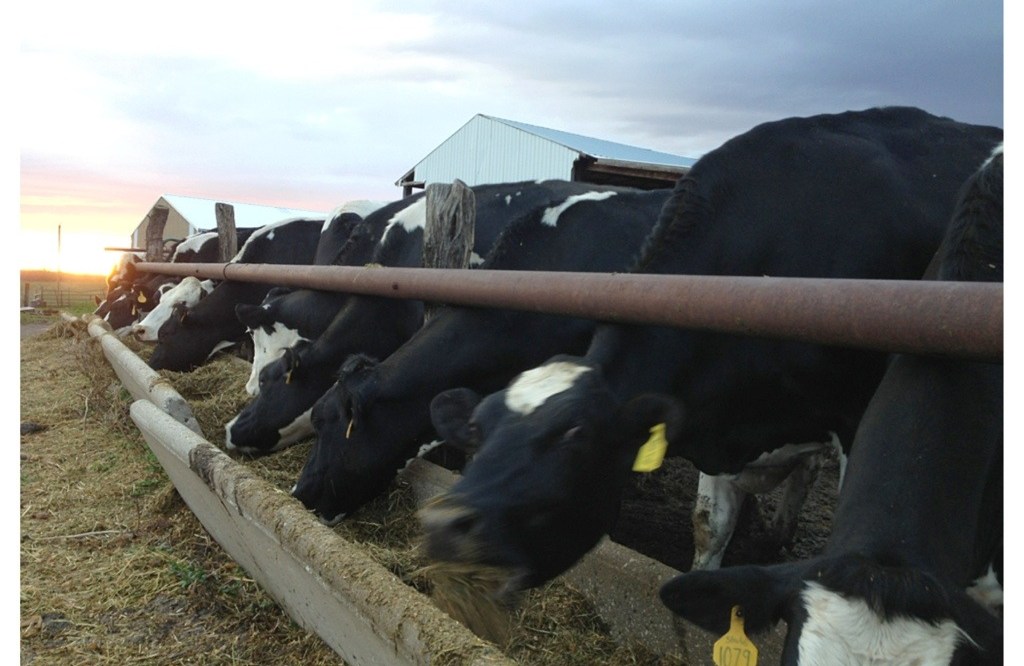
This week we bought a new-to-us TMR wagon. The TMR wagon is what we use to mix feed (TMR) for our cows. I’ve written before about some of the different … Continue reading Mixing It Up
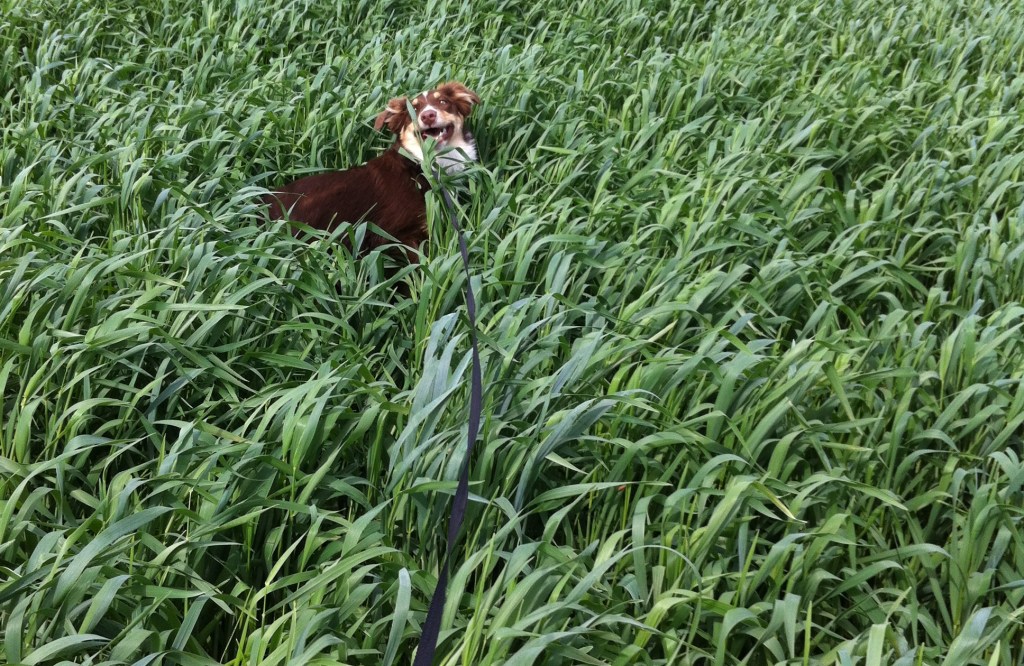
Today is National Agriculture Day. I often write about what we do as a part of agriculture, but today I want to talk about why we do it. Michele Payn-Knoper … Continue reading National Ag Day: Why do we farm?

Our pulsators are something we rely on every day, twice a day, like so many things at the dairy. When everything’s working correctly we can forget how vital things like … Continue reading The Pulse of Milking
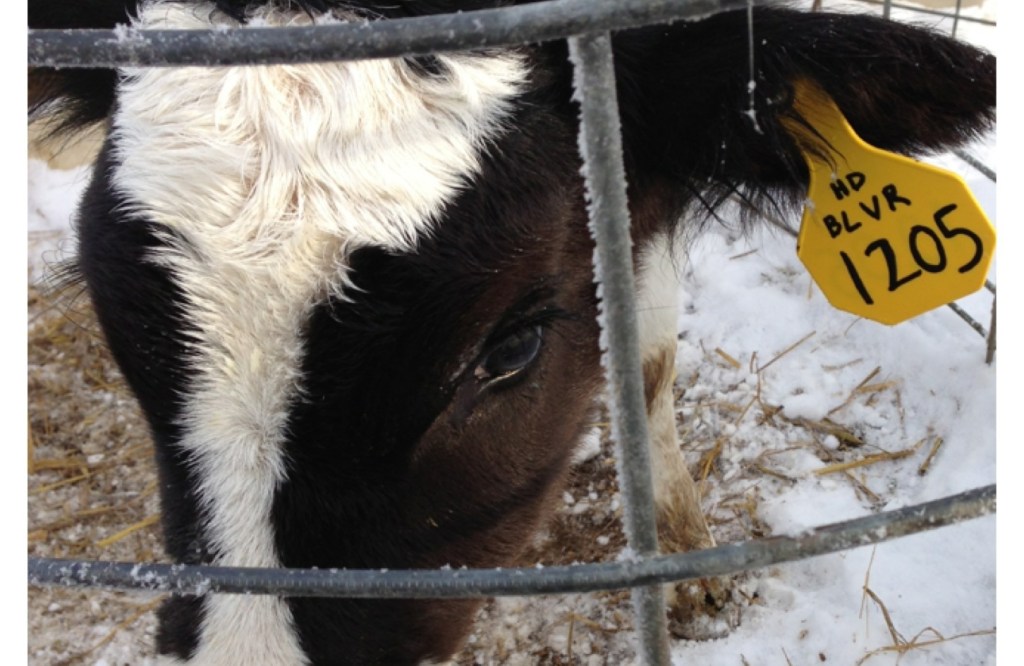
Pregnant cows and heifers within 2-3 weeks of their due date live in the pasture closest to the dairy. When it’s raining or extremely cold, we’ll bring the pregnant ladies … Continue reading A Calf Is Born
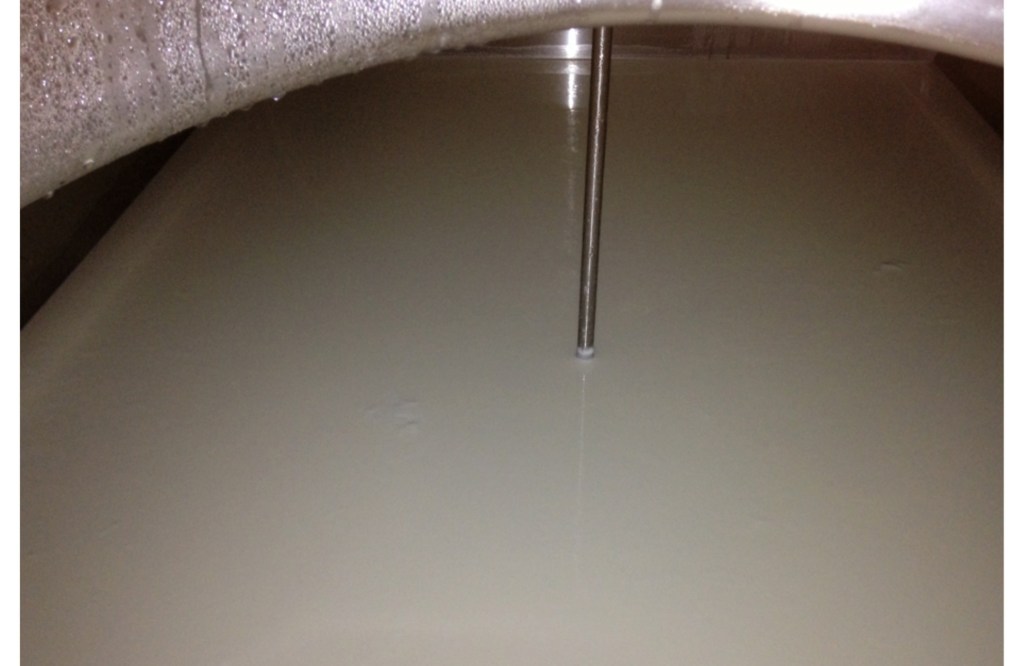
A few weeks ago, The Bullvine posted an interesting article about how milk is losing it’s market share. It also pointed out something seemingly obvious that I had never really … Continue reading Milk: Keeping It Clean
This week the temperature started off with a high of 75 degrees on Monday. Once it started cooling off, it apparently forgot to stop. Friday morning the temperature was right around zero. We’re used to getting cold weather; we’ve had a couple of days with single digit lows already this year. It’s winter, so it’s okay.
The item of note isn’t the weather, but rather, the work the weather creates. I’ve heard it said that farmers don’t work in the winter. Clearly, those saying such a thing aren’t referring to dairy farmers since the cows still have to be milked twice a day every day, just like they do during the other seasons.
It’s true that in the spring, summer and fall there are additional activities like planting, putting up hay, and harvesting to fill the “free time” we aren’t spending milking or doing chores. In the winter, though, there are still other additional activities to fill our time, especially when the weather turns wet and/or cold like it did this week.
We use straw for bedding for our cows and calves, and when it’s wet or cold, we have to freshen that bedding every few days to keep everybody warm and dry. We also have to spend extra time feeding and watering. Young calves in particular need extra attention to ensure that the weather isn’t causing any illnesses like pneumonia. Keeping things consistent for our animals is important, but unfortunately the weather is out of our control and isn’t always consistent. We give the calves a little extra to eat during cold weather, and we don’t do anything drastic like weaning them (stop feeding them milk) right before a cold snap.

The calf groups that aren’t on pasture get hay year-round, and the cows get their forages in their TMR. However, we keep dry cows, bred heifers and a couple of heifer groups on pasture. During the warmer months (as long as it rains) they have grass to snack on. Once the frost kills that grass, we supplement that part of their diet by delivering hay to their pastures.
We also spend a notable amount of time watering everything in the winter. The milk herd and dry cows along with a couple of heifer groups have frost-free waters that make this process easy. In extreme cold we do need to make sure the floats don’t freeze, but we haven’t had trouble with that this year. The rest of the calves have water sources that can and do freeze. Our youngest groups have tubs filled with water and one group in a rented pasture has a small pond. All of these water sources need to have the ice broken on them at least once a day every day in cold weather.
Equipment doesn’t like the cold either. Our milking and feeding equipment can all struggle in the cold. During our first cold snap this winter, the heater in our milk barn wasn’t working. We used a smaller heater to help ease the chill, but we still had to use warm water to thaw out the units before every milking. We also have to use engine block heaters on tractors and our skid loader to make sure that they start.
It seems like every daily task takes longer when the temperature drops. Getting dressed in the morning takes longer with all of the layers required to stay warm. Lugging around all of those layers also makes tasks slower and more tiresome. And when it’s really cold, the farmers need breaks to warm up inside or near the exhaust of the skid loader. The days are also shorter. We work both before and after dark, but some tasks can only be done, or are much more easily done, with daylight, and we have that much less time each day to complete those tasks.
So if you’ve ever wondered how we fill the time we don’t spend in the field during the winter, now you know. We’re working hard to keep our animals and ourselves warm and healthy.
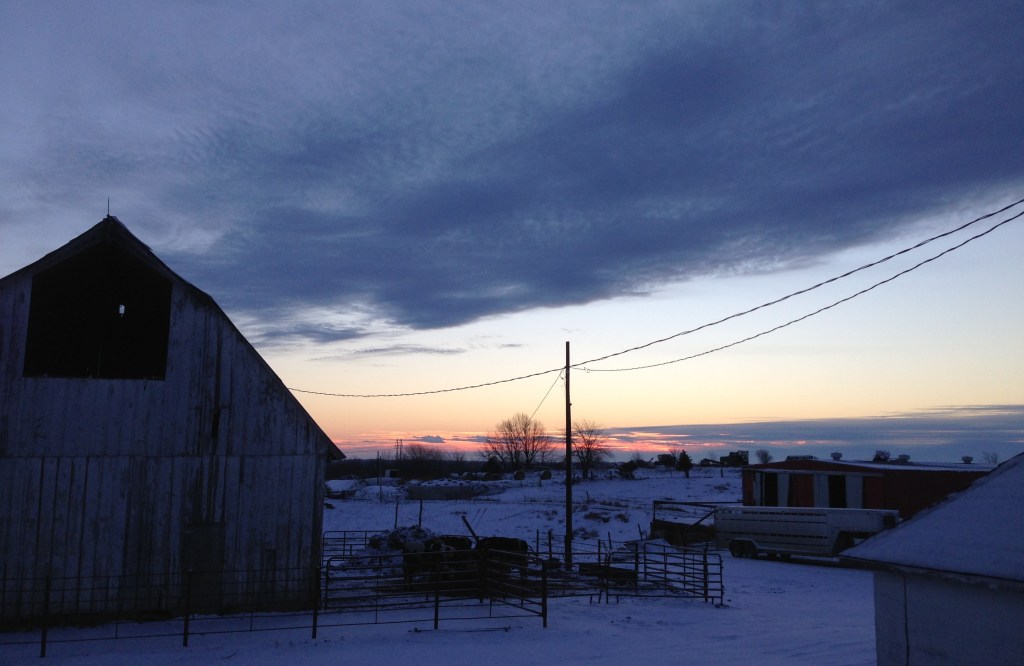
Snow was lightly falling on the farm as 2012 came to a close. To celebrate, we ate chili and watched ABC’s live coverage of Times Square. At 11 pm, we … Continue reading Hitting Refresh
This spring I wrote about a not-so-new technology we were going to try for the first time: sexed semen. We bought 10 units of sexed Chase from ABS. We knew the conception rate was reduced by the process they use to alter the semen, but we were still a little disappointed with our results. To date, we have used 6 of the 10 straws and only achieved one pregnancy. With conventional semen we average about 60% conception, so this is big drop.
The semen wasn’t the only problem, though. Every once in a while we will have a few weeks or a month where conception rates are low. Unfortunately we used several straws of Chase during one of these times. We never determined if it was something in our ration, the stage of the moon or the weather, but for about a month in late winter/early spring we didn’t get much bred.
We did, however, get one pregnancy. In fact, it was one of only two pregnancies achieved during that month. Even better, the pregnant heifer was Snowball: one of our favorites, sired by Aftershock. Snowball’s due date was December 21st. Thankfully the world didn’t end, but on December 22nd as we packed our bags to visit my family in Illinois before Christmas, Snowball stood around chewing her cud and showing no interest in calving.
The next morning while we enjoyed our coffee in Illinois, David and I were mentioned in a tweet (from one of our employees) that contained a picture of a pretty little heifer calf. Sexed semen offers a 90% chance at a heifer, so with only one pregnancy, a bull would have been pretty poor luck. This year, though, it seems like we’ve had plenty of that! We were relieved to come home to a nice fresh cow and baby heifer calf, who is the spitting image of her mama. This little gal is special, so she probably needs a name. Suggestions are welcome in the comments!
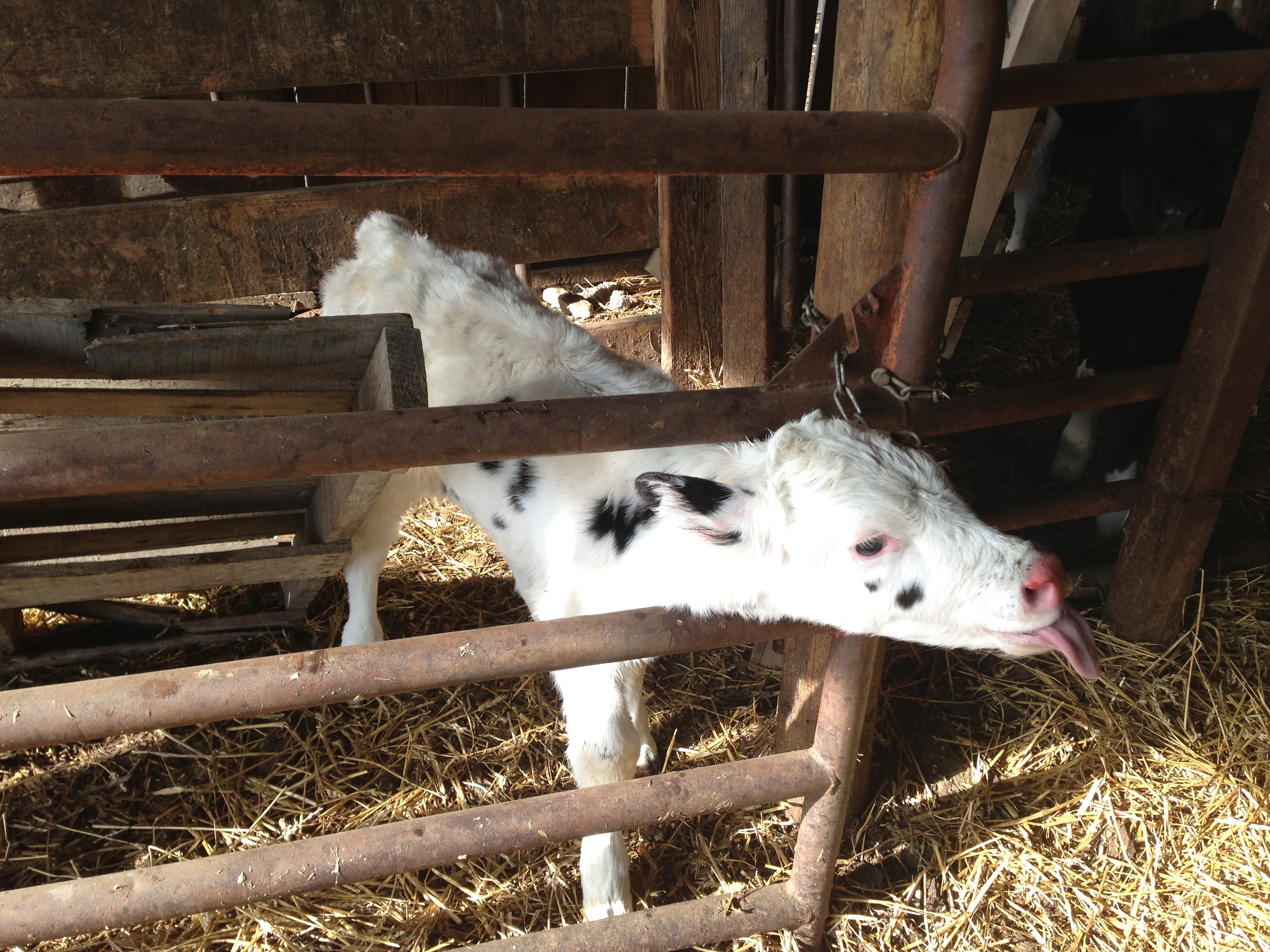
While we were very frustrated with our initial conception results, we still have two straws to use and plan on purchasing some more sexed semen from a different bull or two. Ten units of one bull doesn’t seem like a fair test of a technology that many farmers have been using for years. In the meantime, we’re glad our first try resulted in at least one success story.
Saturday morning the Pleasant Ridge FFA dairy judging team visited the farm for a practice before their first competition. Aaron, one of our milkers, is on the team. He and our other milker, Tyler, selected four classes of cows and calves for the team to judge.
FFA stands for Future Farmers of America. The organization teaches high school students about agriculture through judging and showing competitions. Of the kids who visited our farm, some had a livestock background, but many did not, and I don’t think any had a dairy background. In high school David was very involved in FFA, and his coach Mr. Silvers is still leading the program at PR.
I don’t know the specific rules of dairy judging, but I’ll share what I do know. At the competition, the students will look at some number of classes that each include four animals of similar age. Each animal is marked 1, 2, 3, or 4 for identification purposes. They judge and place these animals based on their body structure. For some of the classes at the competition, the students will have to give reasons explaining their placements. Mr. Silvers has been teaching them about good and bad qualities to look for, mostly using slides. Seeing real animals before competition is where we fit in.
For practice, we started with a class of calves just under a year old. The team had several minutes to inspect the calves before placing them. After they were finished, Mr. Silvers “talked” the class presenting his placing and reasons. It was interesting that the calf he placed last is the one we expect to make the best cow, but we have the advantage of knowing her genetics and that she was the youngest in the class (and also the smallest). He explained to the kids that judging calves can be difficult and that often a young class will place very differently after the animals have matured. For those interested, a Trigger calf was first, and a Planet calf was fourth.

The second class was breeding age heifers 1 to 2 years old. In this class, three were sired by Sholten and displayed similar qualities making it a pretty difficult class. The process was basically the same as the first class. Mr. Silvers suggested that the students look from 20′ in addition to 5′ because different things might stand out. The only non-Sholten, an Aftershock, took second. She was the oldest in the class and isn’t bred yet despite several attempts, but she does look good. The first place Sholten heifer was confirmed bred to Boliver last month.
The third class was 3-year-old cows. This class was easiest to place from the view shown below. If you’d like to give it a try, place the class in the comments section. Do keep in mind this was only a couple of hours after milking. First place was sired by Pippen and is one of the best looking fresh heifers we’ve had. The fourth cow cracked David’s ribs while he was breeding her and didn’t stick. She’s destined for a trailer ride when her production drops.

The fourth and final class was aged cows. For this class, Mr. Silvers asked the kids to place them and take good notes. He didn’t talk the class so he could have the kids give their reasons in class on Monday. We had a little excitement when one of the aged cows decided to try to jump the gate. She got hung up, but we got her over and she seems perfectly fine. The top rail of the gate didn’t fare as well.
The boys threw in a little bit of a curve ball for this class: a very nice 3-quartered cow. She probably would have been #2 in the class otherwise, but with one dry quarter, she automatically falls to fourth. This cow milks better than many four-quartered cows, but that doesn’t matter in livestock competitions. Some of the students noticed, and others learned a valuable lesson.
We really enjoyed having the students visit the farm. We were able to answer some general dairy questions, and they got to see real milk cows before their first competition. Placing classes isn’t an approach we often take to evaluating our animals, and it was actually really interesting to see how they stacked up. Looking at their eartag numbers on paper, I would have placed the classes very differently than I did looking at the animals isolated side-by-side.
Thanks to the team for coming out, and good luck at the district competition!
 HeimDairy